


From complete edentulism to a fixed smile in a single day
Tooth loss is not merely an aesthetic issue; it is a serious health problem that leads to a wide range of adverse effects, from impaired chewing function and speech difficulties to facial collapse and a loss of self-confidence.
Traditionally, removable dentures were the only solution for patients who had lost all their teeth; however, modern dentistry has transformed this situation with the All-on-4 treatment concept. This article explores in depth how a full arch of fixed teeth can be achieved using just four implants, the technical details of the procedure, and the benefits it offers to the patient.
Advanced Technology Behind Our All-on-4 Dental Implant Treatment
For patients considering All-on-4 dental implants in Turkey, we use a digital treatment workflow that combines 3D planning, guided implant surgery and customized full-arch prosthetics. Each stage is planned according to the patient's jawbone anatomy, oral health and individual treatment requirements.
What is All-on-4?
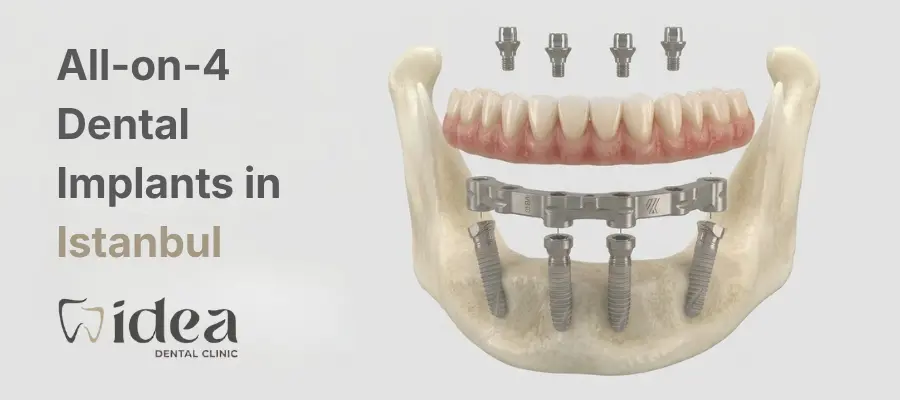
All-on-4 is a rehabilitation protocol developed for patients who are completely edentulous or whose existing teeth need to be extracted; it enables a full dental arch (bridge) to be fixed in place on the same day using just four dental implants.
The fundamental philosophy of this concept is to provide a rapid and stable solution by utilizing the patient’s existing bone to the maximum extent, often without the need for additional bone surgery (such as bone grafting). Whilst traditional methods may require 8–10 implants per jaw, the All-on-4 system makes this process far more efficient.
The power of the 45-degree angle
The most significant technical feature distinguishing the All-on-4 system from other implant treatments is the angle at which the implants are placed. In the system, the four implants are positioned as follows:
- Front region: Two implants are placed vertically (axially) in the front part of the jaw.
- Rear region: The two implants at the back are placed at an angle of up to 45 degrees.
Why an angled implant?
There are several reasons for placing posterior implants at an angle:
- Bone support: Angled placement increases the implant’s contact surface with the bone, providing strong support even in cases of low bone volume.
- Protection of vital structures: It allows avoidance of areas requiring protection, such as the maxillary sinuses in the upper jaw and the inferior dental nerve (mental foramen) in the lower jaw.
- Avoiding bone grafting: In most patients, bone loss is more pronounced in the posterior regions. Thanks to the angled placement, the denser, higher-quality bone in the anterior region is utilized, eliminating the need for laborious bone grafting procedures.
- Wide support area: Increasing the distance between implants distributes the load of the prosthesis (up to 12 teeth) more evenly.
What are the characteristics of the implants and prostheses used in the All-on-4 system?
In summary, the All-on-4 system offers rapid and durable rehabilitation through the combination of angled titanium implants and fixed prostheses with a titanium framework produced using CAD/CAM technology, without the need for additional surgical procedures such as bone grafting
The key characteristics of the components used in this system:
Characteristics of the implants
- Material and technology: Implants are typically made from bioactive titanium, which integrates biologically with bone. Implants used in systems such as NobelSpeedy feature a TiUnite surface that promotes bone growth and patented grooves.
- Abutments: Multi-unit abutments are used to secure the prosthesis onto the implants. These components offer 17° and 30° angled options and different gingival heights to ensure the prosthesis sits passively on both straight and angled implants.
Characteristics of the prosthesis
- Temporary prosthesis (same-day function): The temporary prosthesis, which is screwed onto the implants immediately after surgery (on the same day), is usually made of acrylic material. This temporary bridge ensures that the patient is not left without teeth and can support up to 12 teeth.
- Permanent (Final) prosthesis: Permanent restorations, fitted once the healing process (4–6 months) is complete, are manufactured from more durable materials. The options are as follows:
- Framework: Permanent bridges are manufactured from a single-piece biocompatible titanium monoblock using CAD/CAM technology to ensure precise fit and durability; this ensures the prosthesis fits the mouth perfectly (passive fit).
- Superstructure Materials: Depending on the patient’s needs, acrylic teeth, composite veneers, or individually crafted ceramic/zirconia crowns—which are far more aesthetic and robust—can be placed on the titanium framework.
- Stability and comfort: As the prostheses are screwed onto the implants, they are fixed; they do not move around in the mouth like traditional dentures, do not require denture adhesive, and provide a natural tooth-like sensation.
Material selection and quality standards
There are three main categories of the final restorations for All-on-4 treatment, depending on the patient’s budget and aesthetic expectations:
- Basic: Acrylic teeth and gums are applied to a titanium frame. This alternative is low-cost and feasible.
- Medium: A titanium framework is used with a composite veneer. It has good aesthetics and is easy to repair in the clinic.
- Premium: Custom-made NobelProcera ceramic (zirconia or alumina) crowns that are bonded to a titanium framework. It has great looks and the best durability.
What is the difference between All-on-4 and All-on-6?
The main differences between the All-on-4 and All-on-6 treatment concepts are the number of implants, the type of support, and the suitability of the patient’s bone structure. The main differences between these two techniques are the following:
- Number of implants: The most obvious difference is the number of implants supporting each dental arch. The All-on-4 method utilizes 4 implants in the jawbone. The All-on-6 method utilizes 6 implants in the jawbone.
- Support and stability: The All-on-6 method uses a larger number of implants, which means more support, stability, and anchor points for the denture arch. The two extra implants help spread the chewing forces more evenly over the jawbone.
- Bone requirements and suitability: The volume and density of the patient’s jawbone are assessed with a CBCT (computed tomography) scan to determine the method of choice. All-on-6 requires generally more bone volume and density. All-on-4 can be a solution even for patients with more limited bone volume, as the use of angled placement of implants in the posterior area reduces the need for bone grafting.
- Cost and surgical procedure: All-on-4 requires fewer implants and components, making it a more economical and less invasive (requiring less surgical intervention) option than All-on-6. In All-on-6, the surgery may take a little longer due to the higher number of implants.
- Similarities: Both methods are suitable for the ‘Teeth in a Day’ protocol; i.e., with both All-on-4 and All-on-6, patients can get their fixed teeth on the same day as the surgical procedure. Both systems use implants in the form of titanium posts that serve as a permanent root for the new teeth.
When should I consider All-on-4 versus All-on-6?
The best way to determine which method is appropriate for you is through the results of a CBCT scan, in which your dentist evaluates the volume and density of your jawbone. Both of these systems replace missing teeth to help preserve the shape of your face, restore chewing function, and improve speech.
The choice of All-on-4 versus All-on-6 is primarily determined by the condition of your jawbone (volume and density), the support level you require, and your budget. Both are suitable for the ‘teeth in a day’ concept, but the choice may be based on the following circumstances:
In which cases should All-on-4 be chosen?
- Limited bone volume: All-on-4 is ideal for patients with severe bone loss in the jawbone, especially in the posterior sections. The posterior implants are placed at a 45-degree angle to get maximum support from the anterior area where the bone is densest.
- No bone grafting: The All-on-4 system often avoids the need for the labor-intensive and costly bone grafting procedures when there is little bone volume.
- Less invasive procedure: With fewer implants (4) being used, the surgical area is more limited, and the recovery process may be more comfortable for the patient.
- Cost-effectiveness: It is a far more economical solution compared to traditional methods requiring 8–10 implants.
In which cases should All-on-6 be chosen?
- Sufficient bone mass and density: If your jawbone is wide and strong enough to support six implants, All-on-6 may be a suitable option. Your dentist will assess this using a CBCT (computed tomography) scan.
- Maximum stability and support: All-on-6 provides more ‘anchor’ points to support the entire dental arch. This helps distribute chewing forces across a wider area of the jawbone.
- Strong chewing force: If you have very strong chewing muscles or want the extra security of more anchor points, 6 implants can offer greater stability.
The All-on-4 procedure in ‘Teeth in a Day’
The ‘Teeth in a Day’ procedure, which is performed with the All-on-4 treatment concept, is designed to immediately improve the quality of life of the patient by performing a rehabilitation that would take months with conventional techniques in just one day. This process, which allows the patient to leave the clinic with fixed teeth in just a few hours, consists of a series of meticulously planned stages.
Stage 1: Evaluation and digital planning
This is the most important stage before treatment starts:
- Clinical assessment: The dentist evaluates the health of the existing teeth, gums, and bone structure.
- 3D imaging: CBCT scans (computed tomography) provide a three-dimensional view of the volume and density of the jawbone.
- Virtual planning: With the help of computer software, the perfect position and angles for implant placement are determined digitally with millimeter precision.
Stage 2: Surgical procedure (Surgery day)
On the day of surgery the patient receives the appropriate type of anesthesia (local, sedation, or general), and the surgery begins.
- Preparation: All problematic teeth in the mouth are removed, and the bone surface for the implant placement is shaped (bone contouring).
- Placement of the implants: Two straight implants are placed in the anterior part of the jaw, and two angled implants (up to 45 degrees) are placed in the posterior.
- Advantages of placement at an angle: This technique provides optimal support of the bone and eliminates the risk of compromise to important structures such as the sinus or mandibular nerve.
Stage 3: Abutments and temporary teeth placement
Loading is performed on the same day, immediately after the implants placements:
- Abutment connection: Screwing of the multi-unit abutments onto the implants.
- Temporary bridge: Immediately after surgery, the fixed acrylic bridge is attached to these abutments using screws (prefabricated). Thanks to this prosthesis, the patient does not leave the clinic toothless, they recover the ability to speak and chew lightly on the same day.
4. Stage: Osseointegration healing phase
The All-on-4 procedure is critical during the phase of osseointegration when the titanium implants are biologically joined to the jawbone, providing a solid base on which the permanent teeth are to be fixed. The details of this period and points to note are as follows:
Timeline and duration
- Healing time: The implants normally take 3 to 6 months (sometimes 4–6 months) to fully meld with the bone. In this time, the jawbone grows into and over the special grooves on the implant surface, making it part of the body.
- Delayed loading: If during the surgery the implants do not achieve adequate tightness (at least 35 Ncm torque), your dentist may suggest covering the implants and allowing the healing process to take its course (delayed loading) instead of going ahead with ‘teeth in a day.’
Biological process: TiUnite technology
Bone formation: The special TiUnite surface used in systems such as Nobel Biocare allows the bone to bind directly to the pores and grooves on the implant surface. This technology helps to maintain the stability (tightness) of the implant during the osseointegration process.
Nutrition and the necessity of a ‘soft diet’
- Restrictions: The most important rule at the osseointegration period is to have a soft diet.
- Why is this important? : Chewing hard foods during bone healing can put too much strain on implants that are not yet fully stable, which interrupts the healing process and can lead to the loss of the implant.
Oral hygiene and care
- First few days: Instead of brushing, it is recommended to swab the surgical sites with salt water or special mouthwashes for the first few days to avoid irritating the surgical sites.
- Long-term hygiene: As healing progresses, you should be able to resume normal brushing and flossing to keep the implant surfaces clean and remove food debris.
- Gum Health: Implants don’t decay, but bad cleaning can cause gum disease, which could jeopardize the success of the implant.
Use of temporary prostheses
Function: Temporary acrylic bridges are placed on the day of surgery, and patients wear these during the healing period. This bridge provides an aesthetic solution and, by splinting the implants together, helps keep them immobile during healing.
Stage 5: Completion of the process
- Check-up: The final stage starts when the dentist is satisfied that the bone has healed enough and the gums have healed.
- Transition to the permanent prosthesis: Following successful osseointegration (4-6 months), the temporary bridge is removed, and a final bridge made of more durable materials such as porcelain or zirconium is fitted.
Why All-on-4? Benefits
The All-on-4 system offers patients a number of benefits:
- Instant results: You can go from edentulism to fixed dentures in just a few hours.
- High success rate: Clinical data shows this method has an incredible success rate of 98.3% in the lower jaw and 98% in the upper jaw.
- Preservation of facial structure: Implants stimulate the bone and prevent the loss of the bone that occurs with the loss of a tooth; this avoids drooping of the lips and cheeks, resulting in a more youthful appearance.
- Comfortable and confident: They stay in place and don’t slip like removable dentures, they don’t require any adhesives, and they don’t cover the roof of your mouth so you don’t lose any taste sensation.
- Cost-effective: It is less expensive than traditional full-mouth implant treatments because it requires fewer implants and less surgery, such as no bone grafts.
Who is suitable for All-on-4? (Candidacy and limitations)
Approximately 95% of people who are completely edentulous or have lost most of their teeth are suitable candidates for this treatment. However, caution is required in certain cases:
- Bone dimensions: A minimum of 5 mm width/10 mm height is required in the upper jaw and 5 mm width/8 mm height in the lower jaw. For patients with severely insufficient bone, zygomatic (cheekbone) implants may be an alternative.
- Primary stability: The implants must be secured to the bone with a torque of at least 35 Ncm during surgery; otherwise, immediate tooth loading cannot be performed and healing must be awaited.
- Bruxism (teeth grinding): Patients with a severe habit of teeth grinding or clenching may not be suitable candidates for this system.
Are there any disadvantages to the All-on-4 method?
Although the All-on-4 treatment concept has a very high success rate of approximately 98%, this method does have certain disadvantages, risks, and limitations.
- Failure to correctly identify the inferior dental nerve or the mental foramen in the lower jaw during surgery may result in nerve damage. Similarly, there is a risk of damaging the walls of the maxillary sinus during implant placement.
- For this method to be applicable, a minimum bone height of 10 mm in the upper jaw and 8 mm in the lower jaw, along with a bone width of 5 mm, is required. In cases where these measurements are not met, the more complex ‘zygomatic’ (cheekbone) implants may be necessary instead of the standard All-on-4.
- Dental prostheses do not decay; however, if the surrounding gums are not kept clean, peri-implantitis (gum disease around the implant) may develop. Poor hygiene can also lead to bad breath (halitosis).
- In patients with a very high smile line, the ‘transition zone’ where the prosthesis meets the natural gum may be visible when smiling. In such cases, surgical adjustment of the bone level may be required beforehand.
Post-treatment care: Living with your new teeth
The care guidelines to ensure your new implants last a lifetime are simple but require discipline:
- Hygiene: Implant teeth do not decay, but the surrounding gums can become diseased (peri-implantitis). For this reason, regular tooth brushing and the use of dental floss or interdental brushes are essential.
- Diet: During the initial 4–6-month recovery period following surgery, you must consume soft foods. Once the permanent teeth have been fitted, you can return to your normal diet.
- Check-ups: Regular dental check-ups once or twice a year are necessary to monitor the condition of the implants and the prosthesis.
What is the lifespan of the All-on-4 treatment (implants and prosthesis)?
Thanks to titanium implants, the All-on-4 treatment can be used safely for many years (20 years or more). The prosthetic teeth on top, however, last an average of 15–20 years depending on the materials used and the level of care and can be replaced when necessary.
How much does All-on-4 cost?
Cost:
The cost of All-on-4 treatment varies widely depending on the country, clinic, materials used, and the patient’s individual needs.
Below is a comparison of average costs per arch (upper or lower jaw) in different countries:
| Country | Average Cost Per Arch |
|---|---|
| Turkey | €3,500 - €6,500 |
| United Kingdom | €17,000 - €29,000 |
| Germany | €14,000 - €22,000 |
5 key factors determining the price
- 1.Implant brand: The brand of the implant used (premium brands of Swiss or Swedish origin, such as Nobel Biocare and Straumann, are more expensive).
- 2.Prosthetic material (superstructure): The material used to make the permanent prosthesis is very important. Zirconia prostheses are generally more expensive than metal-acrylic or porcelain prostheses due to their natural appearance and durability.
- 3.Additional surgical procedures: In patients with jawbone resorption, additional procedures such as bone grafting or sinus lifting may be required prior to implant placement.
- 4.The dentist’s experience and the clinic’s location: The experience of the specialist dentist performing the treatment and the city where the clinic is located (for example, prices in Istanbul may differ from those in other provinces) are also factors influencing the cost.
- 5.Scope of treatment: It is essential to clarify whether the quote includes a temporary prosthesis, a permanent prosthesis, all X-ray and CT scans, anesthesia, and follow-up appointments. The most cost-effective quotes may sometimes exclude these items.
F.A.Q:
What is the All-on-4 treatment concept?
This method is a solution that allows a full dental arch (bridge) to be fixed in place on just four implants on the same day for patients who are completely edentulous or whose existing teeth are to be extracted.
Will I experience a lot of pain during or after All-on-4 treatment?
No. The procedure is generally pain-free; however, mild redness, swelling, or discomfort may occur afterwards and last for a few days.
Will I need a bone graft (bone grafting)?
As the All-on-4 system is designed to utilise the existing bone to the maximum extent, it generally eliminates the need for a bone graft.
What exactly is ‘Teeth in a Day’?
It involves fitting a fixed, temporary prosthesis onto the implants on the very day they are placed so that the patient does not leave the clinic without teeth.
What material are the implants made of?
Implants are made of titanium because titanium is ‘bioactive,’ meaning it forms a direct bond with the jawbone to provide a strong hold.
When will my permanent (final) teeth be fitted?
Generally, 4 to 6 months after the operation, once the implants have fully integrated with the bone, the temporary bridge is removed and the permanent bridge is fitted.
Will my All-on-4 teeth look like my natural teeth?
Yes, All-on-4 prostheses are designed to be indistinguishable from natural teeth, both aesthetically and functionally.
What is the difference between All-on-4 and traditional implants?
While traditional methods may require 6–10 implants and additional bone surgery, All-on-4 achieves the same result with fewer implants, less surgery, and at a lower cost.
Will my speech be affected by this treatment?
A slight lisp may occur for the first few days, but most patients return to normal speech within a few days.
How should I clean my implants?
You should brush them with a standard toothbrush and continue to use dental floss; you must also not neglect regular check-ups with your dentist.
What is ‘primary stability,’ and why is it important?
For a tooth to be fitted on the same day, the implant must have a torque value of at least 35 Ncm within the bone; if this cannot be achieved, a healing period is required before the teeth can be fitted.
What can I eat during the healing period?
During the initial 3–6 months whilst the implants are integrating with the bone, a soft diet should be followed to prevent excessive strain on the implants.
I have a teeth-grinding (bruxism) problem; is this treatment suitable for me?
Patients with severe parafunctional habits (such as teeth grinding) are generally not considered suitable candidates for All-on-4 due to the excessive load placed on the implants.
What happens if there is no bone in my upper jaw?
In cases of severe bone loss in the upper jaw, the All-on-4 procedure can be performed using ‘zygomatic’ implants placed in the zygomatic bone.