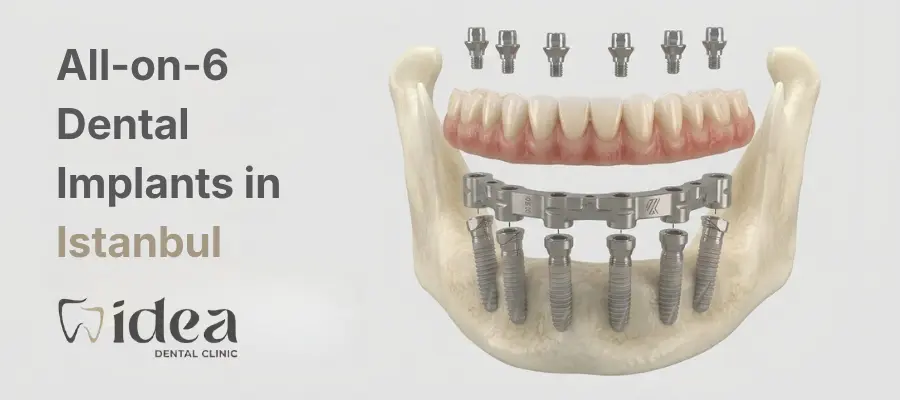



Tooth loss is a serious health issue that directly affects quality of life, self-confidence, and social interaction, particularly among the aging population. While traditional removable dentures were once the standard solution, they have now been superseded by implant-supported fixed solutions due to reduced chewing force, bone loss, and difficulties in use. The All-on-6 treatment concept, one of the most advanced of these modern solutions, combines durability, aesthetics, and functionality in the rehabilitation of completely edentulous mouths.
Advanced Technology Behind Our All-on-6 Dental Implant Treatment
Successful All-on-6 dental implant treatment involves careful implant positioning, adequate bone support and appropriate prosthetic planning. Our digital workflow combines 3D imaging, computer-assisted treatment planning, guided surgery and customized full-arch restorations to create a treatment plan tailored to each patient's anatomy and clinical needs.
What is All-on-6, and how does it work?
All-on-6 is a surgical procedure that uses six dental implants placed at strategic points to support a full dental arch in the upper or lower jaw. In this method, the implants are positioned to distribute chewing pressure across the jawbone in the most balanced way. Particularly in areas where bone density is lower, such as the upper jaw, the use of six implants enhances the system’s stability, thereby increasing the long-term success rate. Once the implants are in place, a fixed prosthesis (bridge) is screwed onto them, giving the patient the feel and appearance of natural teeth.
What are the characteristics of the implants and prostheses used in the All-on-6 system?
Characteristics of the implants used in the All-on-6 system
The implants used in the All-on-6 system form the foundation of the system and have the following characteristics:
- Number and positioning: In this system, six dental implants are strategically placed in each jaw to support a full dental arch. The implants are positioned at points that distribute chewing pressure to the bone in the most balanced manner.
- Material and biocompatibility: Implants are typically made from biocompatible titanium (usually Grade II or similar). Titanium is resistant to corrosion and has the ability to form a direct structural bond with bone tissue (osseointegration).
- Geometric design and surface: Implants are usually root-shaped and feature a threaded design. Their surfaces may have micro-textures, such as sand-blasted or acid-etched finishes, to enhance the attachment of bone cells.
- Placement angle: Implants in the posterior region can usually be placed at an angle of up to 30 degrees to avoid anatomical structures such as sinus cavities or nerve canals and to obtain maximum support from the existing cortical bone.
- Stability: The mechanical retention of the implant at the time of placement (primary stability) and the biological integration during the healing process (secondary stability) are of critical importance for success.
Characteristics of the prostheses used in the All-on-6 system
Types of prostheses:
The system is usually completed with a fixed prosthesis (bridge). However, there are also options for hybrid prostheses supported by six implants that can be mobilized (removed), allowing the patient to clean them.
Materials used:
Framework: Milled titanium, cobalt-chromium alloys, or zirconium frameworks are used to enhance durability and passive fit.
Superstructure: Zirconium, ceramic, acrylic resin, or porcelain materials are preferred for aesthetics and function.
Retention method:
Dentures are typically secured by screwing them onto the implants (screw-retained). Screw-retained systems allow the dentist to easily remove the denture and perform maintenance when necessary.
Customized design:
Dentures are manufactured with micron-level precision using digital scans and CAD/CAM technology to ensure a perfect fit with the patient’s facial structure, smile line, and phonetic requirements.
What is the difference between All-on-4 and All-on-6?
- Number of implants: The most evident variation is the number of implants to support each dental arch. The All-on-4 technique uses 4 implants in the jawbone. The All-on-6 approach uses 6 implants placed in the jawbone.
- Support and stability: All-on-6 involves a larger number of implants, thereby providing more support, stability, and anchor points for the denture arch. The two additional implants help to distribute the chewing forces more equally across the jawbone.
- Bone needs and suitability: A CBCT (computed tomography) scan helps to measure the volume and density of the patient’s jawbone in order to establish the method of choice. Bone volume and density are usually higher in All-on-6. Even for patients with less bone volume, All-on-4 can be a solution, since the use of angled placement of implants in the posterior area reduces the requirement for bone grafting.
- Cost and surgical procedure: All-on-4 requires fewer implants and components than All-on-6, making it less expensive and less intrusive (less surgical intervention). In All-on-6, the procedure could take a little longer due to the larger number of implants.
When to consider All-on-4 vs. All-on-6?
The decision between All-on-4 and All-on-6 largely depends on the condition of your jawbone (volume and density), the quantity of support you need, and your budget. Both of them are ideal for the “teeth in one day” concept; however, the choice may depend on the following circumstances:
When to Opt for All-on-4?
- Limited bone volume: All-on-4 is perfect for patients with significant bone loss in the jawbone, especially in the posterior areas. The posterior implants are angulated 45 degrees to obtain the maximal support of the densest part of the bone in the anterior. No bone grafting: The All-on-4 system often avoids the need for the labor-intensive and costly bone grafting procedures when there is little bone volume.
- Less invasive: Fewer implants (4) are utilized; thus, the surgery is less extensive, and the patient may have an easier recovery.
- Cost-effectiveness: It is a more cost-effective alternative than older procedures requiring 8-10 implants.
When should you choose All-on-6?
- Sufficient bone mass and density: If your jawbone is wide enough and strong enough to hold six implants, you may be a good candidate for All-on-6. This will be assessed by your dentist, utilizing a CBCT (computed tomography) scan.
- Maximum stability and support: All-on-6 offers more ‘anchor’ points to support the whole dental arch. This distributes the forces of chewing over a larger area of the jawbone.Strong chewing force: If you have very strong chewing muscles or want the extra security of more anchor points, 6 implants can offer greater stability.
All-on-6 procedure:
Preparation and digital planning:
Like any successful procedure, All-on-6 begins with meticulous planning. In the initial stage, the dentist assesses the patient’s general health and oral anatomy.
- 3D imaging: Using CBCT (Cone Beam Computed Tomography) and panoramic X-rays, the density and volume of the jawbone are examined in the finest detail.
- Strategic positioning: The points where the implants will be placed are determined digitally to ensure chewing pressure is distributed as evenly as possible across the bone and to avoid damaging critical anatomical structures such as sinuses or nerve pathways.
- Impressions and models: Intraoral scans and working models of the patient are prepared to ensure the prosthesis fits perfectly with the facial structure and smile line.
Surgery:
On the day of the operation, local anesthesia, sedation, or, in some cases, general anesthesia is usually administered for the patient’s comfort.
- Tooth extractions: If there are loose, inflamed, or ‘hopeless’ teeth in the mouth, these are extracted during the operation.
- Implant placement: Titanium implants are placed into the jawbone at the six designated points. At this stage, in the posterior regions where bone volume is limited, implants are usually placed at an angle to maximize support from the existing bone; this often eliminates the need for a bone graft.
- Primary stability: The success of the implants depends on how firmly they are anchored in the bone at the time of placement (primary stability).
Fitting of temporary prostheses (the ‘same-day teeth’ concept):
One of the greatest advantages of the All-on-6 technique is that the patient does not leave the clinic without teeth. If the implants are placed with sufficient stability, a temporary fixed prosthesis is screwed onto the implants immediately after the operation or within a few hours. This temporary prosthesis preserves the patient’s aesthetic appearance and allows them to chew soft foods.
The osseointegration period
The period of 3 to 6 months following the placement of the implants is referred to as ‘osseointegration.’ During this period, a biological bond forms between the titanium implant surface and the living bone tissue, and the implants become part of the jawbone.
The osseointegration and healing period following implant placement is as follows:
The first hours and days:
- As soon as the operation is over, contact between the blood and the implant surface triggers the body’s response of clotting, inflammation, and tissue formation.
- Platelets in the blood prepare the necessary ground for new bone cells to migrate to the implant surface.
- During this process, stem cells begin to differentiate into osteoblasts (bone-forming cells).
The first 2 weeks:
This period marks the onset of the ‘secondary’ or biological stability phase. The mechanical tightness provided when the implant is placed (primary stability) gradually gives way to the bone’s own healing process (biological stability). New bone formation within the spaces between the implant threads and the remodeling of existing bone gain momentum during this stage.
Month 3:
This is one of the most critical stages of osseointegration. Research shows that implant stability (ISQ values) increases significantly within the first three months following placement.
- Maturation: The weak structure formed initially, known as ‘woven bone,’ begins to give way to the more organized and resilient ‘lamellar bone’ during this stage.
- Interim Assessment: In most All-on-6 protocols, temporary prostheses are removed for the first time at the end of the third month to assess the degree of osseointegration.
Months 4–6:
This phase marks the period when the bone has fully matured and the implant has become an integral part of the jawbone.
Preparation for Permanent Prosthesis: Once it is confirmed that the implant has achieved sufficient anchorage (stabilization) within the bone, healing abutments are fitted, and measurements for the permanent prosthesis are taken.
Variations in Duration: Due to the more porous structure of the upper jaw (maxilla) bone, this process can often take up to 6 months, whereas it may be shorter in the lower jaw..
Months 6–8: Final healing for complex cases
In cases such as All-on-6, where all teeth are restored and bone volume is limited, ‘full healing’ and the final delivery of the prostheses may, in some instances, take up to 8 months. This additional time ensures that the bone achieves the highest possible resistance to the full chewing forces that will be exerted on the implants.
Fitting of permanent dentures
Once bone healing is complete:
- Precision impression taking: The healing abutments are removed, and open or closed impression techniques are used to determine the exact positions of the implants in the mouth.
- Material selection: The final prosthesis is fabricated from highly durable and aesthetic materials such as zirconia, porcelain, or metal-supported acrylic.
- Fitting: The prepared full dental arch is screwed onto the implants to secure it. This fixed structure does not move and cannot be removed by the patient; it is cleaned in the same way as natural teeth, using interdental brushes and special dental floss.
All 6 candidates:
All-on-6 treatment isn’t right for every patient, but it is a treatment option that can dramatically enhance the quality of life for those who match certain requirements.
- All-on-6 is most suitable for the most suitable candidates, such as those with total edentulism or those with irreversible existing teeth (terminal dentition).
- This procedure is especially appropriate for those who have problems with the movement, discomfort, or chewing problems with standard removable dentures.
- The group who will profit most from this therapy are those who have had face collapse from loss of teeth and want complete chewing function and a younger, more beautiful look.
- A good candidate must have enough bone height and width to support the implants (usually at least 10–12 mm in length and 3.6 mm in width).
- Thanks to the angulation of the implants, in some patients with bone loss (atrophy), the All-on-6 treatment can be performed without the necessity for other surgical procedures such as sinus lifts. However, these patients might not be direct candidates if the bone loss is substantial and could need bone augmentation surgeries first.
- They are best for those who can maintain prosthesis cleanliness and attend frequent dental check-ups to prevent irritation around the implants (peri-implantitis).
- The patient has to be able to open the mouth at least 50 mm in order for the surgical tools to be able to work; this is a technical need.
- All-on-6 is a more expensive and time-consuming process than standard dentures. It is for those who are willing to invest the money and time to recover.
Those unsuitable for All-on-6
All-on-6 treatment has very successful outcomes in modern dentistry; however, it may not be the best treatment for every patient due to the overall health of the patient, oral anatomy, and living habits. • uncontrolled diabetes: uncontrolled diabetes can negatively impact the implant fusing with the bone (osseointegration) and also raise the risk of infection (peri-implantitis).
- Auto-immune diseases: Diseases that inhibit or change the immune system could limit the success of the implant.
- Cardiovascular issues: Severe heart and vascular problems may enhance the risks associated with surgical intervention.
- Blood issues: Blood disorders, like problems with clotting, could complicate the surgical process.
- History of radiotherapy: Patients that have had radiotherapy to the head or neck region in the last two years are not usually seen as viable candidates, as this may adversely influence bone repair.
- Bisphosphonates: The use of medicines that influence bone metabolism (especially intravenous bisphosphonates) may raise the risk of osteonecrosis of the jaw, which may result in implant loss.
- Insufficient bone volume: You need to have sufficient volume and quality of bone structure to insert the implants. If there is substantial bone resorption or a very poor bone structure, the person might not be a good candidate.
- Smoking – Smokers have a much greater chance of implant rejection due to slower healing of the soft tissues and bone.
- Bruxism (teeth grinding/clenching): Patients who have a bad tendency of clenching their teeth may put additional load on implants, leading to prosthetic fractures or loss of implants.
- Poor oral hygiene: Those with poor oral hygiene or those unable to follow post-treatment hygiene regimens are more at risk of infection.
What should you bear in mind after All-on-6 treatment?
To ensure long-term success following All-on-6 treatment and to extend the lifespan of the implants, there are important considerations to bear in mind both during the post-operative recovery period and during the permanent prosthesis phase.
The early post-operative period and medication use
Immediately following the surgical procedure, the protocol recommended by the doctor should be followed to support the healing process:
- Medication: Corticosteroids may be prescribed to reduce post-operative swelling and inflammation; antibiotics to prevent the risk of infection; and analgesics such as ibuprofen for pain management.
- Mouthwash: Mouthwashes containing chlorhexidine gluconate may be used to support oral hygiene during the recovery process.
- Suture care: Surgical sutures are usually removed approximately two weeks after the operation.
Diet and chewing habits
The osseointegration period—the process by which implants fuse biologically with the bone (typically lasting between 3 and 6 months)—is critical from a dietary perspective:
- Soft Diet: Particularly during the first few months following implant placement, a soft diet should be followed to prevent excessive strain on the temporary prostheses, and hard foods should be avoided.
- Bite Control: As temporary prostheses may not have a metal framework, excessive chewing forces can cause fractures in the prosthesis.
- After Permanent Prostheses: Even after permanent prostheses have been fitted, it is recommended to avoid excessive chewing habits to preserve the prosthesis’s lifespan.
Oral hygiene and home care
Cleaning implant-supported fixed dentures requires different techniques to those used for natural teeth:
- Special cleaning tools: In addition to daily tooth brushing, the use of interdental brushes and super floss (special dental floss) is essential to reach beneath the dentures and around the implants.
- Plaque control: If plaque accumulating around the prosthesis is not removed, it can lead to peri-implantitis—an inflammation of the tissues that may result in implant loss.
Regular professional check-ups
The success of the treatment is directly linked to regular dental check-ups:
- Check-up schedule: Routine check-ups should be carried out every 3 months during the first year following the procedure and every 6 months thereafter.
- Professional cleaning: Professional examinations and plaque removal carried out by the dentist are essential for maintaining the health of the soft tissues surrounding the implants.
- Radiographic monitoring: Periodic panoramic X-rays may be taken to monitor changes in bone levels and the status of osseointegration.
Are there any disadvantages to the All-on-6 method?
The All-on-6 technique is a highly effective and durable solution for full-arch restoration, offering excellent stability and long-term results . However, it comes with specific disadvantages and limitations that you should understand before making a treatment decision.
| Disadvantage | Description |
|---|---|
| More upfront cost | 6 implants are used; hence, the initial cost is higher when compared to All-on-4. |
| More complex and invasive procedure | The placement of the implants in the posterior region (pterygoid or buccal shelf) demands advanced surgical skills and increases the difficulty level of the treatment. |
| Prolonged healing time | Usually the osseointegration (bone fusion) procedure takes 3-6 months of waiting before it is possible to put the final prosthesis. |
| Increased need for bone grafting | Required bone quality and quantity is better than that of All-on-4; hence, the necessity for bone grafting or sinus lifting is higher. |
| Implant failure trend (minor difference) | Some studies have found a slightly greater implant failure rate (5%) compared to All-on-4 (1.25%); however, this is not statistically significant. |
| Increased demands on oral hygiene | With 6 implants, cleaning becomes more difficult every day, especially in the posterior area that is hard to reach. This may increase the risk of plaque buildup and peri-implantitis. |
| Need for a specialized team | The surgeon, prosthodontist, and dental technician must be thoroughly experienced. Such skill may not be available everywhere. |
| Not for all patients | Patients with severe bone loss, uncontrolled diabetes, extensive smoking habits, or poor dental hygiene compliance may be poor candidates for this surgery. |
All-on-4 vs. All-on-6
| Feature | All-on-4 | All-on-6 |
|---|---|---|
| Cost | Lower | Higher |
| Surgical Difficulty | Less | More |
| Bone Grafting Need | Less | More |
| Hygiene Difficulty | Moderate | More Demanding |
| Risk if One Implant Fails | Higher (can compromise the bridge) | Lower (redundancy with 5 remaining implants) |
| Long-term Bone Loss | Slightly higher | Lower |
What is the cost of All-on-6?
Factors determining the price
- Scope and content of the treatment: When researching prices, be sure to ask what is included.
- Implant brand and origin: The brand of the implant used (German, Swiss, Turkish, etc.) directly affects the price. For example, premium brands such as the Swiss-made Straumann are more expensive than domestic brands.
- The prosthetic material used: The material used to make the permanent teeth determines both aesthetics and durability.
Acrylic hybrid prosthesis: A more economical option. It is generally preferred as a temporary prosthesis or for shorter-term solutions.
- Zirconium prosthesis: Offers the highest quality and aesthetics. They are extremely durable, long-lasting (15–25+ years), and have excellent compatibility with the gums, but they are the most expensive option.
- The dentist’s expertise and the clinic’s facilities: The experience of the surgeon performing this complex procedure and the technology they use (such as guided digital surgery) are also important factors affecting the cost.
All-on-6 price comparison (Per arch / Per jaw)
The table below shows the average cost for a complete All-on-6 treatment (including implants, abutments, and a final fixed zirconia or acrylic hybrid prosthesis).
| Country | Average Price Range (USD) | Average Price Range (EUR) |
|---|---|---|
| Turkey | 6,500–6,500–10,000 | €6,000 – €9,500 |
| United Kingdom | 18,000–18,000–28,000 | €16,500 – €26,000 |
| Germany | 17,000–17,000–25,000 | €15,500 – €23,000 |
What is the lifespan of the All-on-4 treatment (implants and prosthesis)?
The life expectancy of the All-on-4 procedure is determined by the implants and the prosthetic bridge. The titanium dental implants bond with your jawbone and are supposed to be a permanent solution lasting 20+ years to a lifetime with adequate care and maintenance. High long-term survival rates have been demonstrated in clinical tests.
On the other hand, the visible prosthetic bridge (set of false teeth) is subject to daily use and wear and tear, so the lifespan is shorter at around 10 to 20 years, but the typical clinical estimate is that the bridge might need to be replaced or relined every 6 to 7 years depending on the bite force, hygiene, and the material used (such as acrylic or zirconia).
F.A.Q:
Is All-on-6 treatment painful?
No. The procedure is usually performed under local anesthetic or sedation, so you will not feel any pain during the procedure.
Will I have teeth straight away after the procedure?
Yes, with the ‘immediate loading’ protocol, a temporary fixed prosthesis can be fitted on the day of the surgery.
Can I remove the prostheses myself?
No, All-on-6 prostheses are fixed structures screwed into the implants and can only be removed by a dentist.
Do I need to have a bone graft?
In most cases, a bone graft is not required thanks to strategic placement; however, it may be necessary if bone loss is severe.
How is All-on-6 care carried out?
Regular brushing, the use of an interdental brush, and special dental floss are required, just as with natural teeth.
Will my speech change after having All-on-6 treatment?
Once you have gotten used to them, the dentures will correct your speech and improve your pronunciation.
Is there an age limit for All-on-6?
There is no age limit for adults whose bone development is complete; the procedure is also successfully performed on elderly patients.
What happens if the prosthesis breaks?
As it is secured with screws, repair or replacement is quite straightforward.
Does sinus sagging prevent treatment?
No, this can be overcome by placing the implants at an angle in front of the sinus cavities.
How often should I attend check-ups?
Generally, check-ups are recommended every 3–6 months in the first year and once a year thereafter.