




At Idea Dental in Istanbul, Turkey, a dental crown is a custom-made cap that covers a damaged or weakened tooth to restore its shape, strength and appearance. Our indicative price is £110–£300 per tooth, depending on the crown material and your treatment plan. Most patients need 3–7 days in Istanbul, although root canal or gum treatment can extend this.
This guide explains when a crown is needed, how the materials compare, what crowns cost and how to look after them.
Our Digital Crown Workflow in Istanbul
A crown has to fit the tooth, the bite and the teeth around it. Where appropriate, our team combines a clinical examination with intraoral scanning and digital design to plan each restoration.
Dental Crowns Before and After in Istanbul, Turkey

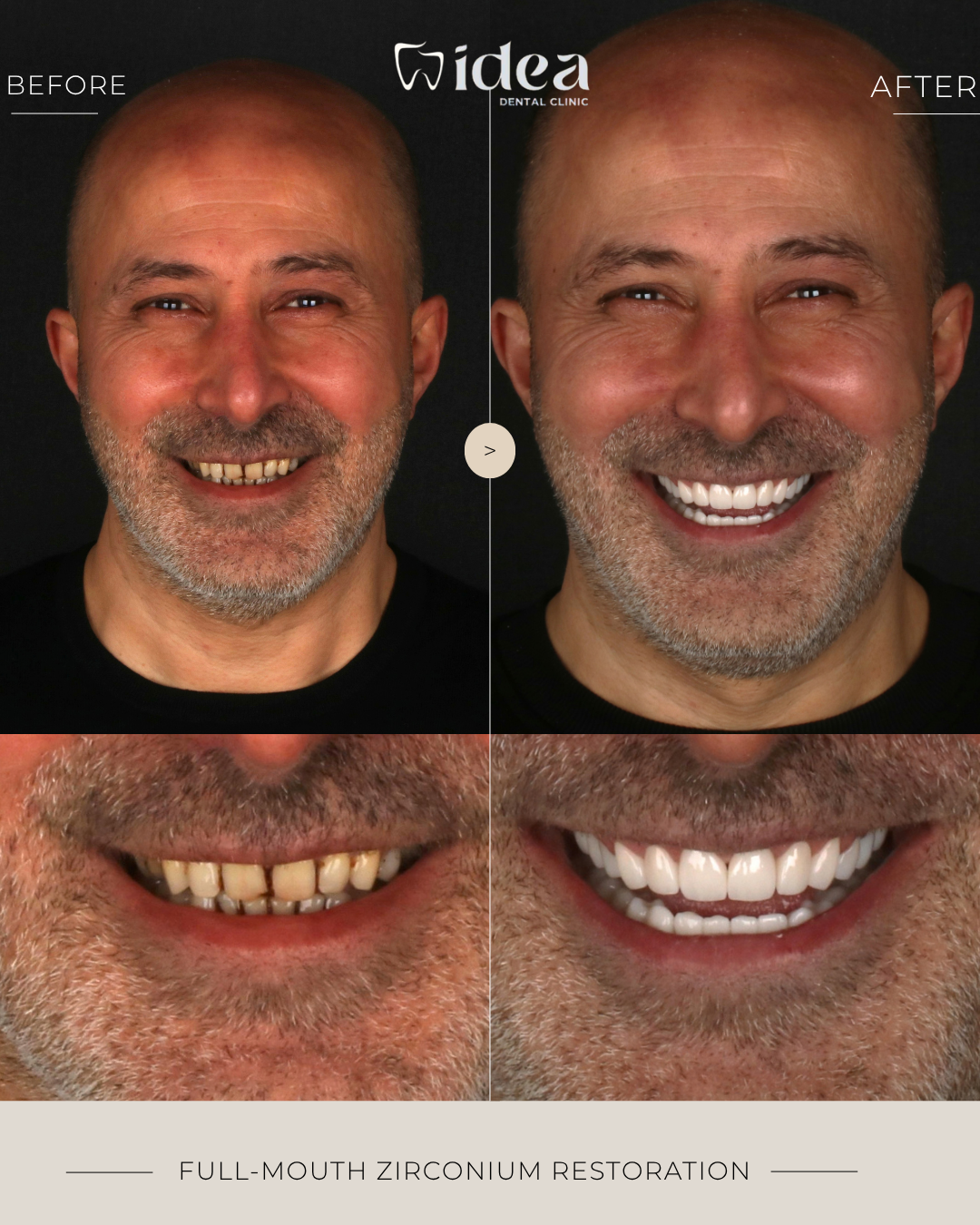
You can see more patient cases in our before and after gallery.
Your Crown Team at Idea Dental
Crowns are prosthetic restorations, so planning the fit and bite is central to treatment. At Idea Dental, Spec. Dent. Can Metiner is a specialist prosthodontist whose clinical work includes zirconium and porcelain restorations, and who medically reviews this guide.
Dr. Ali Can Yeni and Dent. Sefa Ercan Önal also work in prosthetic and aesthetic dentistry. If a tooth needs a root canal treatment first, Spec. Dent. Göze Arukaslan is an endodontics specialist. Before booking, ask our team to confirm who will carry out each stage of your treatment.
What Is a Dental Crown?
A dental crown covers the visible part of a tooth above the gum line. It is made to match your bite and the teeth around it, and it is fixed in place with dental cement.
Crowns are commonly used for:
- Weakened teeth: Teeth with large fillings, cracks or heavy wear.
- After root canal treatment: Protecting a tooth following root canal treatment, when your dentist recommends it.
- Broken teeth: Restoring a tooth that is too damaged for a filling.
- Appearance: Improving a badly discoloured or misshapen tooth as part of cosmetic dentistry.
- Implants and bridges: Covering a dental implant or supporting a bridge.
Crown or Veneer?
A veneer covers the front of a tooth and usually needs less preparation. A crown covers the whole tooth, so it suits teeth that have lost more structure.
Who Is a Good Candidate for a Dental Crown?
A crown may suit you if a tooth is too damaged or weakened for a filling but still has a healthy root. Before treatment, the following points need to be assessed:
- Root and nerve health: Infection should be treated first, and an X-ray is usually needed.
- Remaining tooth: Enough tooth structure is needed to hold the crown, or a core or post may be required.
- Gum health: Gum disease should be treated first.
- Your bite and habits: Teeth grinding puts crowns under extra strain, so you may need a night guard or splint.
Types of Dental Crowns
The right material depends on the tooth, your bite and your appearance goals. Cleveland Clinic’s crown guide describes the main materials and their trade-offs.
| Crown type | Appearance | Strength | Often used for |
|---|---|---|---|
| Zirconia | Tooth-coloured and metal-free | Very strong | Back teeth, and front teeth when suitable |
| E-max (lithium disilicate) | Highly translucent and metal-free | Strong | Visible teeth and single crowns |
| Porcelain-fused-to-metal | Tooth-coloured, but the metal edge may show | Strong | Front or back teeth |
| Metal | Metallic colour | Rarely chips or breaks | Back teeth that are not visible |
The Dental Crown Procedure Step by Step
- Examination: Your dentist checks the tooth, with X-rays where needed, and explains your options.
- Preparing the tooth: Under local anaesthesia, any decay is removed and the tooth is reshaped all round.
- Digital impressions: The prepared tooth is recorded for the laboratory, and a shade is selected.
- Temporary crown: A temporary crown protects the tooth while the final crown is made.
- Fitting: Your dentist checks the fit, colour and bite, then cements the final crown in place.
Temporary crowns are not as strong as final crowns, so avoid hard or sticky foods on that side until your final crown is fitted.
How Long Do You Need to Stay in Turkey?
Most patients need 3–7 days in Istanbul, depending on the case and the material. Several crowns can often be prepared in one trip, although a larger treatment may take longer. If a tooth needs root canal treatment or gum care first, your dentist will confirm the revised schedule.
Stay until your final crowns have been fitted and your bite has been checked, so that any adjustments can be made before you travel.
Dental Crown Cost in Istanbul, Turkey (2026)
The final price depends on the crown material, the number of teeth and any preparatory treatment. The table below lists indicative 2026 prices; your written quote should specify the treatment and services included.
| Treatment | Turkey (Istanbul) | UK (private) |
|---|---|---|
| Dental crown (per tooth) | £110 – £300 | £700 – £1,200 |
| Full set of 20 zirconia crowns | £2,200 – £6,000 | £14,000 – £24,000 |
| Porcelain veneer (per tooth) | £150 – £450 | £700 – £1,400 |
Prices are indicative, and UK figures are broad market estimates. The UK figure for a full set is calculated from the per-tooth range. After reviewing your photos or X-ray, we provide a free, personalised preliminary treatment plan and cost estimate. Your final treatment plan and cost are confirmed after an in-person examination.
What is included in the price?
Before booking, request an itemised quote confirming the crown material, the number of crowns and any laboratory fees. Also confirm whether the consultation, X-rays, temporary crowns and follow-up appointments are included or charged separately. Hotel accommodation and transfers should be listed separately if arranged.
What affects the cost?
| Cost factor | How it affects dental crown treatment |
|---|---|
| Crown material | Metal-supported and all-ceramic crowns differ in price, appearance and suitable uses. |
| Number of crowns | Treating several teeth increases the total price. |
| Preparatory treatment | Root canal treatment, core build-ups or gum care may be needed first and are priced separately. |
| Case complexity | Bite problems or full-arch planning can increase the treatment scope. |
Before booking, confirm accepted payment methods and currencies with our team. If you plan to pay by card, check with your bank about foreign transaction fees before you travel.
How Long Do Dental Crowns Last?
There is no guaranteed lifespan. Cleveland Clinic says crowns last between 5 and 15 years with proper care. How long yours lasts depends on the material, your oral hygiene and the forces on the tooth.
A 2026 systematic review of tooth-supported crowns estimated five-year survival rates of 98.5% for monolithic lithium disilicate, 97.1% for metal-ceramic and 96.8% for monolithic zirconia crowns. These figures come from published studies, not from our own patient records.
Risks and Side Effects
- Sensitivity: It is normal to have some sensitivity to heat and cold for a couple of weeks.
- Sore gums: The gum around the tooth may be tender after treatment.
- Loss of tooth structure: Preparation is irreversible.
- Damage: Crowns can crack, chip or come loose over time.
- Decay: The tooth beneath can still decay, particularly if plaque collects at the edge of the crown.
Contact a dentist if your bite feels wrong or if pain keeps you awake or does not settle.
Aftercare for Dental Crowns
- Cleaning: Brush twice a day and clean carefully around the crown edge with floss or interdental brushes.
- Hard foods: Avoid chewing ice, pens or very hard items on the crown.
- Teeth grinding: Wear a night guard if your dentist recommends one.
- Check-ups: Keep up with regular dental reviews so that wear or gum changes can be spotted early.
Aftercare When You Return Home
Before leaving Istanbul, ask for a record of the teeth treated, the crown material and the shade used. A dentist near home can then monitor your crowns. If you have a concern, send our team a description and photos through our contact page. Ask whether an in-person examination is needed and clarify any return-visit arrangements and costs before travelling.
How to Choose a Dental Crown Clinic in Istanbul
Before choosing where to have treatment, make sure you:
- Know who will treat you. Ask for the name and qualifications of your dentist.
- Ask why a crown is recommended and whether a filling, onlay or veneer would work.
- Ask which material will be used, and have it named in your treatment plan.
- Ask for a written, itemised quote for your treatment, with any transfers or accommodation listed separately.
- Ask about warranty and aftercare and what happens if a crown comes loose after you return home.
Booking your treatment with us is simple:
- Send us your panoramic X-ray or clear photos of your teeth through our contact page.
- Receive your personalised treatment plan and quote, free of charge.
- Confirm your dates. Ask us about airport transfers and accommodation in Istanbul.
Frequently Asked Questions
How much do dental crowns cost in Turkey?
Our indicative price is £110–£300 per tooth in 2026, depending on the crown material. Your written quote should confirm the material and any additional treatment.
Are crowns in Turkey safe and reliable?
Safety depends on your health, the clinician’s assessment, the fit of the crown and follow-up care. Ask which material will be used, who will treat you and what aftercare is available.
How long does it take to get a crown in Turkey?
Most patients need 3–7 days, depending on the case and material. Preparatory treatment can extend this, and your dentist will confirm the schedule.
Can I get multiple crowns done in one visit?
Often, yes. Several teeth can usually be prepared in one trip, although the number treated at once depends on your teeth and your comfort. Your dentist will plan the sequence.
Is it painful to get a dental crown?
Your dentist numbs the area, so you should feel pressure rather than pain. Some sensitivity and gum tenderness afterwards is normal. Tell your dentist if pain keeps you up at night or does not improve.
Do crowns require special care?
Crowns do not need special products, but they do need careful cleaning, particularly around the gum line. Avoid very hard items, and wear a night guard if you grind your teeth.
Can a crown be whitened?
No. Whitening only lightens natural teeth, so if you want whiter teeth, finish whitening before your crown shade is chosen.
Is there a warranty for dental crowns?
Warranty terms vary, and they may not cover damage from accidents or teeth grinding. Ask our team what applies to your treatment and request the terms in writing before you book.
Medical Sources and Further Reading
These resources support the general information about crown types, lifespan and side effects on this page. They do not verify our clinic’s prices or individual patient results.
- Cleveland Clinic — Dental crowns: crown types, procedure, lifespan and side effects.
- Pjetursson BE et al., International Journal of Prosthodontics (2026): systematic review of survival and complications of tooth-supported single crowns.
Get Your Free Dental Crown Plan in Istanbul
Send us your panoramic X-ray or a few clear photos of your teeth and our team in Istanbul will prepare your personalised treatment plan and quote, free of charge.
Get your free treatment plan →
Follow our patient results on Instagram: @ideadentalclinic
Medically reviewed by Spec. Dent. Can Metiner, Specialist Prosthodontist · Published: October 30, 2026
