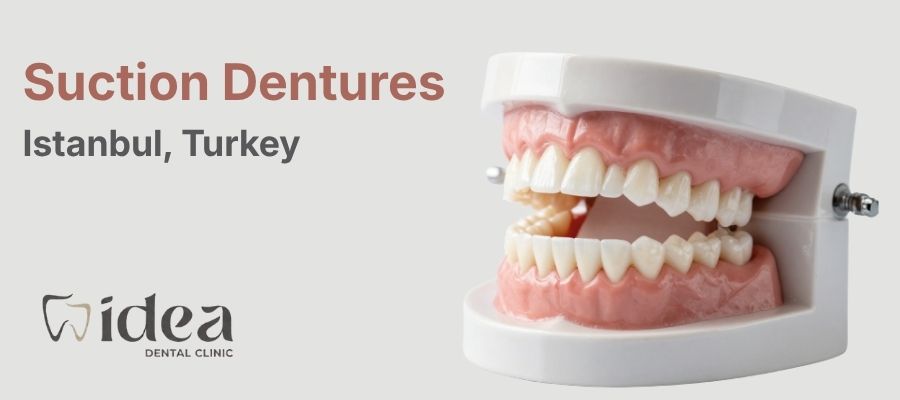



What Is a Suction Denture?
A suction denture, sometimes described as a vacuum-retained denture, is a complete removable prosthesis designed for people who have lost all of their teeth in one or both jaws. It helps restore appearance and functions such as chewing and speaking. The term “suction denture” refers to the enhanced retention achieved through close adaptation to the oral tissues and an effective peripheral seal.
Contrary to common belief, these dentures do not contain a mechanical vacuum device. Their retention depends on several factors, including the fit between the inner surface of the denture and the supporting tissues, the seal around the denture borders, saliva, and the patient’s oral anatomy and muscle control. When these factors are favourable, they can reduce slipping and rocking during everyday activities. Complete dentures are commonly made with an acrylic resin base; in selected cases, a dentist may recommend a soft lining material to improve comfort.
Suction Denture Treatment in Istanbul, Turkey
To learn more about suction denture treatment, determine which option may be suitable for you, and plan your care, you can contact Idea Dental Clinic through our contact page. To receive detailed information about suction denture prices and make an appointment in Istanbul, Turkey, talk to our dentists about a treatment option based on your oral anatomy and individual needs.
What Are the Advantages of a Suction Denture?
When suitable for the patient and fabricated accurately, suction dentures may offer several benefits:
- Natural, aesthetic appearance: The shape, shade, and arrangement of the prosthetic teeth and gum-coloured base can be customised to create a natural-looking result.
- Improved stability and confidence: An effective fit and peripheral seal may reduce denture movement and help patients speak, smile, and eat with greater confidence.
- Reduced need for adhesives: Good retention may reduce reliance on denture adhesives, although results vary according to oral anatomy and other clinical factors.
- Comfortable use: Accurate impressions, appropriate border design, and balanced pressure distribution can improve comfort and reduce areas of excessive pressure. Adjustments may still be required after delivery.
- No surgery required: Unlike dental implants, conventional suction denture fabrication does not require implant surgery, incisions, or stitches.
- A more economical option: A removable complete denture is generally more affordable than an implant-supported fixed restoration, although fees vary according to the treatment plan.
Types of Suction Dentures
The design and expected retention of a complete denture depend on the jaw being treated, the patient’s anatomy, and the condition of the supporting tissues.
Suction Denture Types
- Upper complete denture: A complete denture for an edentulous upper jaw. The palate and surrounding tissues provide a broad supporting area, which may help create an effective peripheral seal when anatomical conditions are favourable.
- Lower complete denture (SEMCD approach): Achieving the same level of retention in the lower jaw is generally more difficult, owing to tongue movement, muscle activity, and a smaller supporting area. The Suction-Effective Mandibular Complete Denture (SEMCD) approach addresses this using detailed functional impressions and carefully designed borders to improve the seal where the patient’s anatomy allows it.
Related but Different: Other Removable and Implant Options
These options are sometimes discussed alongside suction dentures because they serve a similar purpose — replacing missing teeth with a removable or implant-supported prosthesis — but they do not rely on the same peripheral-seal retention mechanism, so they are not suction dentures in the strict sense:
- Removable partial denture: Designed for patients who still have some natural teeth. Retention may be provided by clasps, rests, precision attachments, or other components connected to the remaining teeth. Because it does not normally form a continuous peripheral seal, it is not classified as a suction denture.
- Implant-retained overdenture: A removable denture retained by implants placed in the jaw. Its stability comes primarily from the implant attachments rather than suction, making it a distinct treatment option that should be assessed and discussed separately with your dentist.
Who Is Suitable For a Suction Denture?
Suction denture treatment may be considered for patients with the following needs or circumstances:
- Patients who have lost all teeth in the upper or lower jaw
- Individuals who are dissatisfied with a removable complete denture that slips, rubs, or makes chewing and speaking difficult
- People whose oral anatomy and soft tissues allow an effective denture fit and peripheral seal
- Patients who prefer a non-surgical treatment or have been advised against implant surgery following an appropriate medical and dental assessment
- Those seeking a practical and comparatively economical complete denture option
Suitability and the degree of retention that can be achieved vary between patients. Severe ridge resorption, limited saliva, mobile soft tissues, muscle activity, and certain anatomical conditions may affect the result.
How Is a Suction Denture Performed?
The suction denture process involves several clinical appointments and laboratory stages. Treatment may take approximately 4 to 6 appointments and may be completed within 1 to 3 weeks, although the schedule varies according to the clinical situation, required preliminary treatment, and laboratory workflow. The process generally progresses as follows:
- Initial examination and oral assessment: The dentist evaluates the jaw ridges, soft tissues, bite, existing dentures, and any remaining teeth. Radiographic imaging may be requested when clinically indicated. Active oral disease and any teeth with a poor prognosis are assessed and treated before denture fabrication begins.
- Impression-taking stage: This stage has an important effect on fit and retention. A preliminary impression is taken first. A custom tray may then be prepared for a more precise impression using functional border-moulding techniques that account for lip, cheek, and tongue movements.
- Bite registration: The relationship between the upper and lower jaws is assessed, the appropriate facial height is established, and the bite is recorded to support comfortable function.
- Teeth setup try-in: A trial version of the denture is evaluated in the mouth. Tooth shade, position, appearance, bite, and speech are checked, and adjustments can be made with the patient’s input.
- Final delivery and early follow-up: The finished denture is checked and delivered. The dentist demonstrates how to insert, remove, and care for it. A follow-up appointment is commonly arranged to identify and adjust pressure points or sore areas.
Suction Denture Usage Guide and Adjustment Period
The production time of a denture and the time needed to become accustomed to it are not the same. Adaptation often takes several weeks and varies according to the patient’s anatomy, muscle control, and previous denture experience. During this time, the following practices may help:
- Eating habits: During the first weeks, choose softer foods such as soups, yogurt, purees, soft meatballs, and cooked vegetables. Take small bites and chew gently on both sides to help balance the denture. Hard, sticky, or very fibrous foods may be difficult during early adaptation. An upper complete denture covers the palate, so temperature perception may change; take care with very hot foods and drinks.
- Speech exercises: Temporary increased salivation and changes in pronunciation can occur during the first few days. Practising speaking and reading aloud may help the tongue and facial muscles adapt. Contact the clinic if speech difficulties persist or the denture feels unstable.
How to Remove a Suction Denture
A well-retained denture should be removed carefully to protect the oral tissues and avoid dropping it:
- Stand over a folded towel or a sink partly filled with water so the denture is less likely to break if dropped.
- Follow the insertion and removal technique demonstrated by your dentist because it may differ according to the denture design and jaw anatomy.
- Use gentle, controlled pressure at the appropriate border to release the seal; do not force, twist, or bend the denture.
- If the lower denture is difficult to remove, ask your dentist for a demonstration rather than repeatedly applying excessive force.
Cleaning and Care Recommendations
Complete dentures require regular professional review because the oral tissues and jawbone can change over time. Good daily care can help protect the denture and supporting tissues:
- Daily cleaning: Rinse and clean the denture after meals using lukewarm water and a suitable soft denture brush.
- Avoid abrasive toothpaste: Standard abrasive toothpaste may scratch the denture surface and encourage plaque and stain accumulation. Use a cleaner recommended for the denture material and follow its instructions.
- Give tissues a rest: Unless your dentist advises otherwise, remove the denture at night to allow the oral tissues to rest and to reduce the risk of irritation and denture stomatitis.
- Store it correctly: Store the denture as directed by your dentist or the material manufacturer. Depending on the material, clean water or an appropriate denture solution may be recommended. Avoid hot water, which can distort some dentures.
- Oral hygiene: Even without natural teeth, clean the gums, palate, and tongue gently every day.
- Loss of retention and check-ups: Bone and soft-tissue changes or weight loss can make a denture loose. A dentist should assess whether adjustment, relining, rebasing, or replacement is appropriate; relining cannot correct every cause of lost retention.
Suction Denture Prices in Istanbul, Turkey
The cost of a suction denture can vary according to the patient’s oral anatomy, the jaw or jaws being treated, the denture design and materials, laboratory procedures, and any preliminary care required. For this reason, an individual treatment fee can usually be confirmed only after an assessment.
The main factors affecting the price of a suction denture include:
- Whether a complete denture or a different type of removable prosthesis is planned
- Whether treatment is required for the upper jaw, lower jaw, or both
- The denture base material, type of prosthetic teeth, and whether reinforcement or a soft lining is required
- The condition of the jaw ridges and oral soft tissues
- Whether tooth extraction or other preliminary treatment is required
- The scope of the impression, bite-registration, and try-in procedures
- The laboratory workflow and time required to prepare the custom denture
- Whether a conventional denture or a separate implant-retained option is planned
- Follow-up appointments and necessary adjustments included in the treatment plan
Patients who want to learn about suction denture treatment prices in Istanbul, Turkey should first undergo a clinical examination by a dentist experienced in complete denture treatment, or a prosthodontist. After the assessment, the clinic can prepare an individualised treatment plan and provide current pricing information.
To receive detailed information about suction denture prices and make an appointment in Istanbul, Turkey contact Idea Dental Clinic through our contact page.
Why Choose Idea Dental Clinic for Suction Denture Treatment?
Choosing where to have a complete denture made can influence its fit, comfort, function, and long-term maintenance. Accurate impressions, appropriate border design, careful laboratory work, and regular follow-up all contribute to the treatment outcome.
- Experienced clinical team: Our dentists have experience in complete and partial denture treatment, including functional impression techniques used to improve retention in more challenging cases such as the lower jaw. Spec. Dent. Can Metiner, Specialist Prosthodontist, provides prosthetic treatments, including full-mouth rehabilitation and advanced removable and implant-supported prosthetic care.
- Individualised treatment planning: Every patient’s oral anatomy, ridge condition, and denture history are different. Your treatment plan is based on a clinical examination rather than a standard protocol applied to every patient.
- Modern impression and laboratory workflow: We use functional border-moulding techniques and work with an in-house/partner dental laboratory to reduce the number of adjustment visits needed after delivery.
- Clear communication in English: Our clinical team and coordinators can guide international patients through each stage of treatment, from the initial consultation to post-delivery follow-up.
- Care beyond delivery: We schedule a follow-up appointment after your suction denture is delivered to check for pressure points and make adjustments, and we remain available for future check-ups, relines, or rebasing as your oral tissues change over time.
Frequently Asked Questions
Do suction dentures fall out?
A well-designed suction denture aims to remain stable during normal speaking, smiling, and eating, but no level of retention can be guaranteed for every patient. Results depend on oral anatomy, the condition of the supporting tissues, saliva, muscle control, and the accuracy of the denture fit. Retention can also decrease as the jawbone and soft tissues change over time.
Does suction denture treatment hurt?
Conventional denture fabrication does not involve implant surgery. Impression-taking and fitting are generally well tolerated, although some patients may experience temporary pressure points or sore areas after delivery. These can usually be assessed and adjusted during follow-up appointments. Persistent pain should be evaluated rather than accepted as part of adaptation.
Is there a denture option that does not have to be removed by the patient?
Suction dentures are removable and should generally be removed at night for cleaning and to allow the oral tissues to rest. Patients seeking a restoration that is not routinely removed at home may be assessed for an implant-supported fixed bridge, including treatment concepts such as All-on-4 or All-on-6. These treatments require clinical and radiographic assessment and are not suitable for every patient.
What is the difference between a suction denture and a normal Denture?
All well-made complete dentures depend on accurate impressions, appropriate border design, tissue contact, and a balanced bite. A suction denture places particular emphasis on creating and maintaining an effective peripheral seal to enhance retention. The improvement that can be achieved depends on the patient’s anatomy and clinical conditions.
Can you eat while wearing a suction denture?
Yes, a suction denture is intended to be worn while eating. During the adjustment period, choose softer foods, take small bites, and chew gently on both sides. Hard, sticky, or very fibrous foods may initially be difficult. Chewing ability varies between patients, and a removable denture does not reproduce the performance of natural teeth or an implant-supported fixed restoration.
Are suction dentures removed at night?
Yes, suction dentures should generally be removed before sleeping unless the dentist gives different instructions for a specific clinical reason. Removing them at night allows the oral tissues to rest and may reduce irritation and denture stomatitis. Clean the denture and store it according to the dentist’s instructions and the requirements of its material.
How long does a suction denture last?
There is no fixed lifespan that applies to every suction denture. Many complete dentures remain usable for several years, but their fit and condition should be reviewed regularly because the jawbone, oral tissues, bite, and denture materials change over time. Some dentures may need adjustment, relining, rebasing, or replacement earlier than others.
If the denture cracks, becomes loose or discoloured, affects chewing or speech, or causes pressure sores, arrange a dental assessment. The dentist can determine whether repair, adjustment, relining, rebasing, or replacement is appropriate.