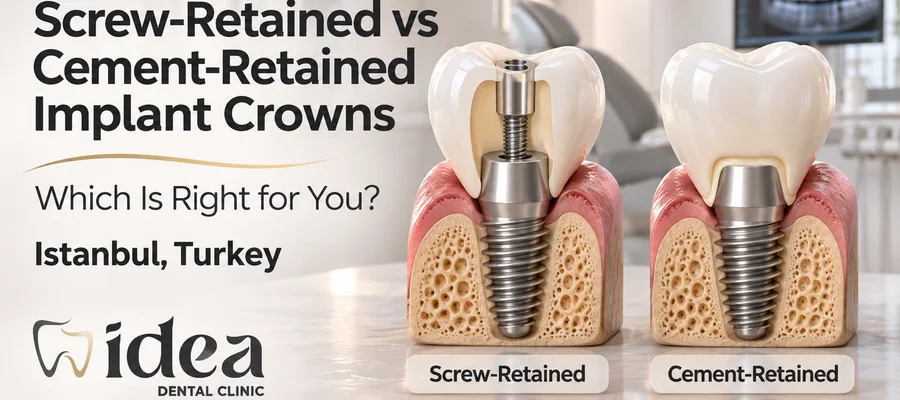




If you have read our page on implant-supported prosthesis in Istanbul, you will have noticed a short section on a question many patients never think to ask: how is the crown actually attached to the implant? It sounds like a small technical detail. In practice, it affects how your new tooth looks, how easy it is to look after and what happens if something ever needs fixing.
In this guide, we take a closer look at that question. We explain the two main options, screw-retained and cement-retained, in plain language, along with their pros and cons and how we decide between them at Idea Dental Clinic.
A Quick Reminder: How an Implant Tooth Is Built
Every implant restoration has three parts. The implant sits in the jawbone and acts as the root. The abutment connects the implant to the tooth above the gum. The crown is the part you see when you smile.
Screw-retained and cement-retained describe how that crown is held in place. This applies to fixed restorations such as single implant crowns, implant bridges and full-arch bridges. Removable overdentures work differently, and we cover them further down.
What Is a Screw-Retained Implant Crown?
With a screw-retained crown, the crown and abutment are usually joined into one piece. A small screw passes through the crown and tightens directly into the implant. The tiny access hole is then sealed with a tooth-coloured filling, so it blends in with the rest of the tooth.
The key benefit is that the dentist can remove it. If the crown needs a repair, a professional clean or a closer look at the gum around the implant, the dentist opens the small filling, unscrews the crown and lifts it off. This can usually be done without damaging the crown.
Pros of Screw-Retained Crowns
- No cement under the gum. Leftover cement around an implant has been linked to inflammation of the surrounding tissues. With a screw-retained design, that risk simply is not there.
- Easy maintenance. The crown can come off and go back on, which makes check-ups, repairs and adjustments much simpler over the years.
- Works in tight spaces. When there is little room between the upper and lower jaws, a screw holds the crown securely where a cemented crown may not grip well.
- The standard for full-arch bridges. Fixed full-arch treatments such as All-on-4 and All-on-6 are normally screw-retained, so the bridge can be removed by the dentist for cleaning and maintenance.
Cons of Screw-Retained Crowns
- The access hole. On back teeth, it is rarely noticeable. On front teeth, it depends on the angle of the implant. Angled screw channel systems now allow the hole to be moved to the inner side of the tooth in many cases.
- Screw loosening. This is a possible technical complication. The dentist checks the cause and the condition of the components before retightening or replacing the screw. If a screw or component is damaged, though, removing the crown can be more complicated.
- High precision needed. The crown must fit the implant exactly, so careful planning and lab work are essential.
What Is a Cement-Retained Implant Crown?
With a cement-retained crown, the abutment is screwed onto the implant first. A separate crown is then cemented on top of it, very much like a crown on a natural tooth.
Because there is no screw hole, the surface of the tooth is completely uninterrupted.
Pros of Cement-Retained Crowns
- Seamless appearance. With no access hole, the dental technician can shape and colour the whole tooth freely.
- A familiar technique. The process is similar to placing a conventional crown.
- An uninterrupted biting surface. Without a screw access hole, the chewing surface can be shaped without allowing space for an access filling. Both retention methods still require an accurately fitting restoration; cement should not be used to compensate for a poor fit.
Cons of Cement-Retained Crowns
- Excess cement. This is the main concern. If cement escapes under the gum and is not fully removed, it can irritate the tissue around the implant and contribute to peri-implant inflammation. The deeper the crown edge sits under the gum, the harder it is to clean every trace away.
- Harder to remove. If a problem appears later, the crown may need to be cut off and remade rather than simply unscrewed.
- Needs enough height. A cemented crown relies on the height of the abutment for grip, so it is less suitable where space is limited.
Screw-Retained vs Cement-Retained at a Glance
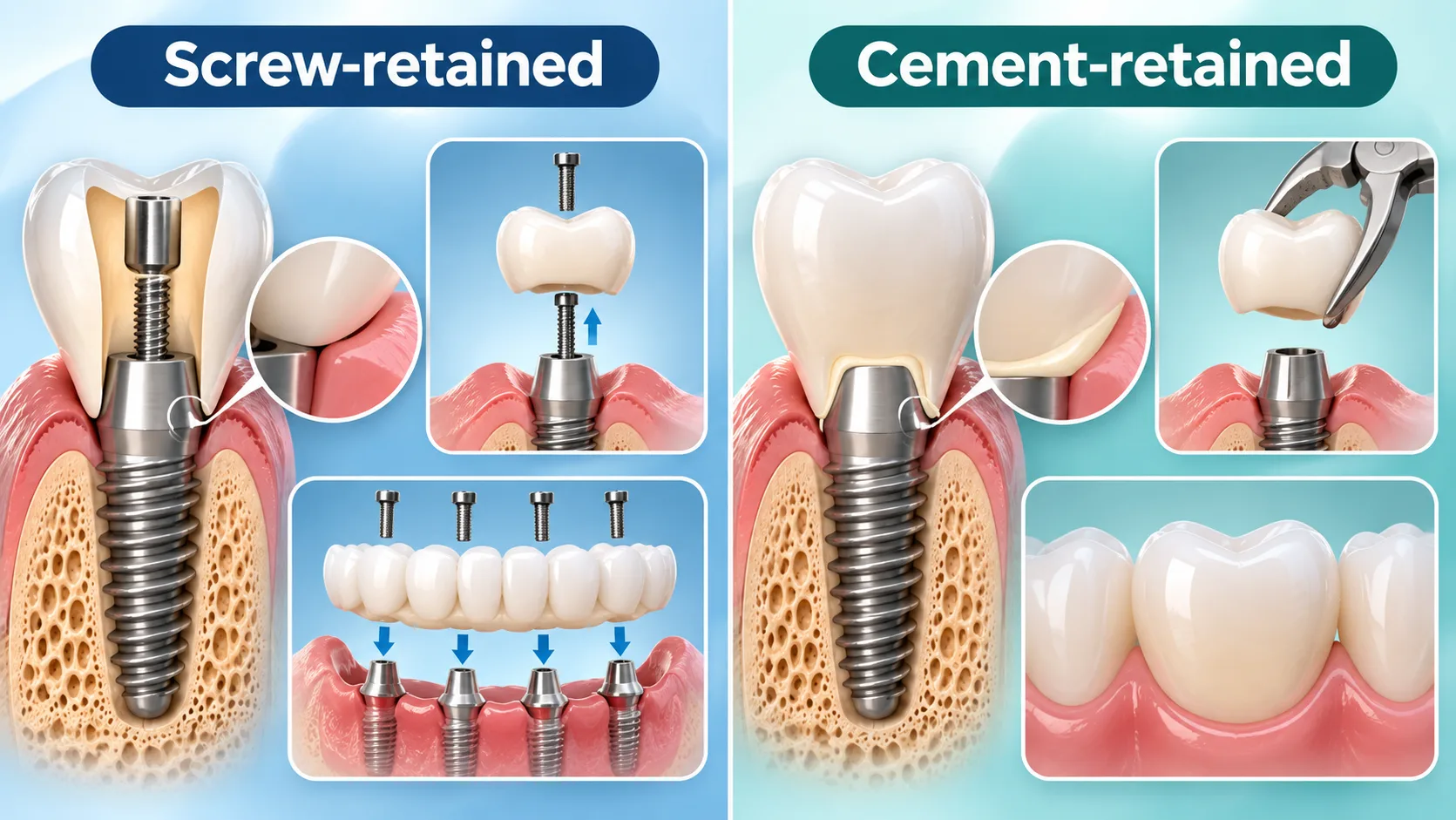
| Screw-retained | Cement-retained | |
|---|---|---|
| Appearance | With good implant positioning or an angled channel, can look just as natural | No access hole |
| Gum health | No risk of leftover cement | Leftover cement must be carefully removed |
| Repairs and check-ups | Far easier to take off and put back | May need to be cut off and remade |
| Limited space | Usually holds better | Needs enough abutment height for grip |
| Full-arch bridges | The standard approach | Less common |
| Front teeth with a difficult implant angle | Depends on whether an angled channel is suitable | May sometimes be the more practical choice |
Screw-retained or Cement-retained? Finding the perfect fit for your smile depends on your unique oral structure, aesthetic goals, and clinical needs!
Find out which implant restoration choice is right for you.
Why We Usually Prefer Screw-Retained Restorations
At Idea Dental Clinic, we generally prefer screw-retained designs whenever the case allows it. An implant is meant to last for many years, and over that time you will need check-ups and possibly small repairs. Being able to remove the restoration without damaging it makes all of that simpler and safer for the tissues around the implant.
Why do we prefer screw-retained systems for implant-supported prostheses? Without the use of cement, the prosthesis is mechanically secured, allowing for greater control and easy access when needed.
Discover the details in our video.
That does not mean cement-retained crowns are wrong. When an implant’s angle would put the screw hole in a visible spot and an angled channel is not suitable, a carefully planned cemented crown, with its edge kept close to the gum line so excess cement can be removed, can be a very good solution. The decision is always made case by case, based on your 3D scans, your bite and how you want your smile to look.
What About Removable Overdentures?
Everything above applies to fixed teeth. Implant overdentures are different: they are removable dentures that clip onto implants using locator, ball or bar attachments. If you are comparing fixed and removable options, our implant-supported prosthesis page explains how these attachments work and how the choice between fixed and removable is made. You can also read more about conventional removable dentures.
Questions to Ask at Your Consultation
- Will my crown or bridge be screw-retained or cement-retained, and why?
- If it is cemented, how will you make sure no cement is left under the gum?
- If something breaks, how easy will it be to remove and repair?
- Which implant brand and crown material will you use?
- What maintenance and follow-up will I need after I go home?
Clear answers to these questions are a good sign that your treatment has been planned with the long term in mind.
Frequently Asked Questions
Can people see the screw hole on a screw-retained crown?
On back teeth, almost never, because it is sealed with tooth-coloured material. On front teeth, an angled screw channel can often place the hole on the inner side of the tooth, where it is not visible.
Is a screw-retained crown less strong than a cemented one?
No. Both are strong enough for normal chewing when they are planned and made correctly. The main differences are in maintenance, retrievability and gum health, not in everyday strength.
Does the choice affect the price?
The retention method can affect the price, along with the implant system, crown material and complexity of the case. You can find indicative prices in the cost section of our implant-supported prosthesis page, and your final quote will follow your examination and 3D imaging.
What happens if my screw-retained crown feels loose?
Contact your dentist as soon as you notice it. In most cases, the screw is simply retightened and the access hole is sealed again. Leaving it loose for a long time can damage the screw or other components.
Are All-on-4 and All-on-6 bridges screw-retained?
Yes, fixed full-arch bridges such as All-on-4 and All-on-6 are normally screw-retained so the dentist can remove them for professional cleaning and check-ups.
Final Thoughts
Screw-retained and cement-retained implant crowns both have a place in modern dentistry. Screw-retained designs make maintenance easier and avoid residual cement around the implant, which is why we use them whenever possible. Both methods can develop biological and technical complications, so careful planning and regular follow-up remain essential. Cement-retained crowns remain a useful option in certain situations, especially for front teeth with challenging angles.
If you would like to know which option suits your case, contact Idea Dental Clinic in Istanbul for a free consultation. Our dentists will review your scans, explain your options clearly and give you a written treatment plan before anything begins.
Reviewed by Spec. Dent. Can Metiner, Specialist Prosthodontist - Founder Dentist. Last reviewed: .